Checklist
The SEO Checklist analyzes your page across 7 categories and 20+ checks. Each issue comes with a clear description and a fix suggestion. Resolve all issues to push your SEO score toward 100.
ℹ️ Keyword
Missing main keyword
The main keyword field is empty. Without a main keyword, the app cannot evaluate keyword density, keyword placement, or most other content checks.
Missing related keywords
The related keywords field is empty. Related keywords add context and help your page rank for a broader range of search queries.
🎯 Technical SEO
H1 tag
You should add only one heading 1 (H1 tag) in your page.
Think of H1 like the title on the cover of a book. It helps indicate the only topic of the page to readers and search engines.
For example: In product page, H1 usually is your product name.
In short, using only one H1 per page is recommended because:
- It clearly signals the main topic of your page to both readers and search engines.
- It creates a clear content hierarchy, improving user experience and readability.
- Search engines give special weight to the H1 tag when determining what your page is about.
Missing product structured data
This product page has no Product structured data. Without it, Google cannot display rich results like price, availability, and ratings in search.
Missing article structured data
This blog post has no Article structured data. Article schema helps Google understand your content type and display it properly in search results.
Duplicate title
You have more than one title in the same page or different pages.
This can confuse search engines, making it unclear which page should rank for a specific keyword, ultimately affecting your site's visibility in search results.
🖇️ Link recommend
Missing internal links
No internal links found in your page.
Internal links are links that connect different pages within your website.
Internal links act like a roadmap for both users and search engines, guiding them through your website. According to Google's guidelines (opens in a new tab), internal links help Google discover new content and understand the structure of your site.
Missing external links
No outbound links found in your page.
Outbound links are links from your website that point to external websites.
These links can improve the relevance and authority of your content by showing search engines that you are linking to trusted, high-quality sources.
✍️ Main content
Main keyword density
The main keyword density is outside the optimal range. Too low means search engines may not understand your topic; too high looks like keyword stuffing.
Related keyword density
One or more related keywords are missing from your content or fall outside the optimal density range.
Content length off target
Your content is shorter or longer than the recommended word count for this page type.
Paragraphs off target
Some paragraphs are too long or too short, making the content harder to read.
Sentence length off target
Some sentences are too long, which reduces readability and can lose the reader's attention.
Missing main keyword in subheading
None of your subheadings (H2, H3) contain the main keyword. Subheadings help search engines understand content structure.
Missing main keyword in introduction
The main keyword does not appear in the first paragraph. The introduction is one of the strongest signals for search relevance.
🏷️ Meta tags
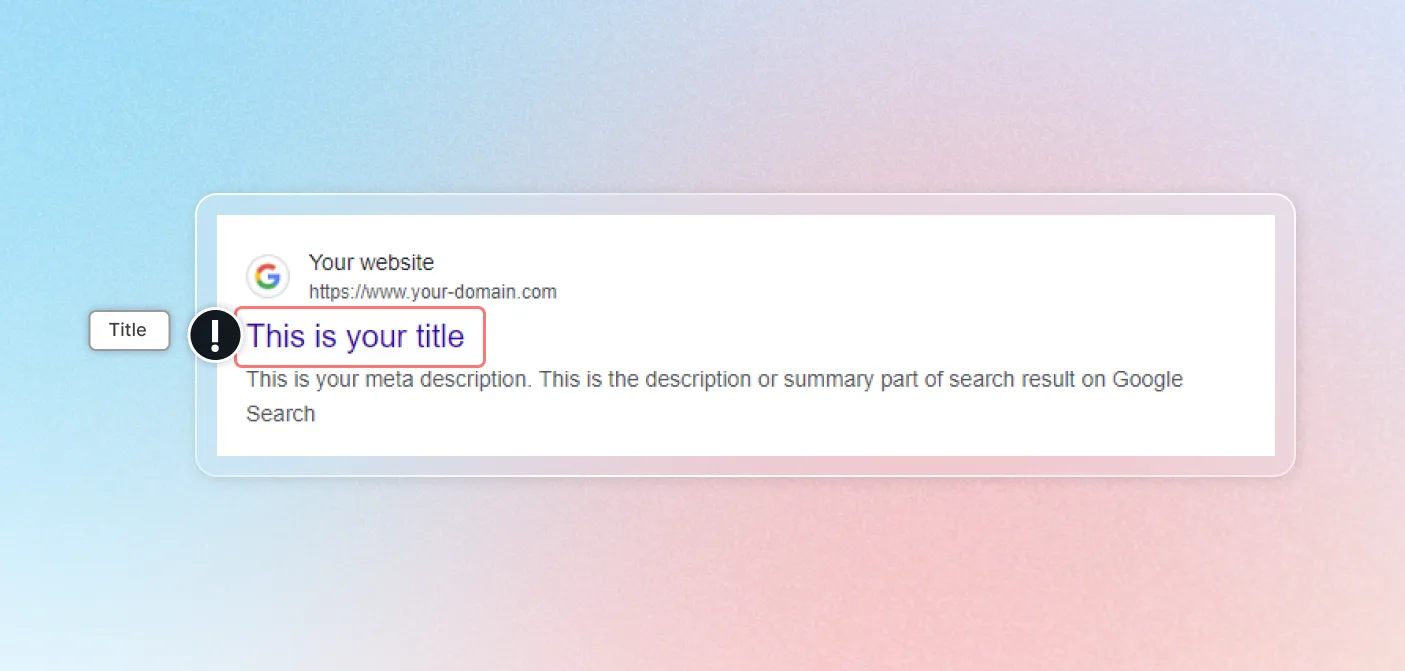
Meta title length off target
The meta title is shorter than 50 or longer than 70 characters. Titles outside this range may be truncated in search results or fail to convey enough information.
Learn more about title with Google (opens in a new tab).
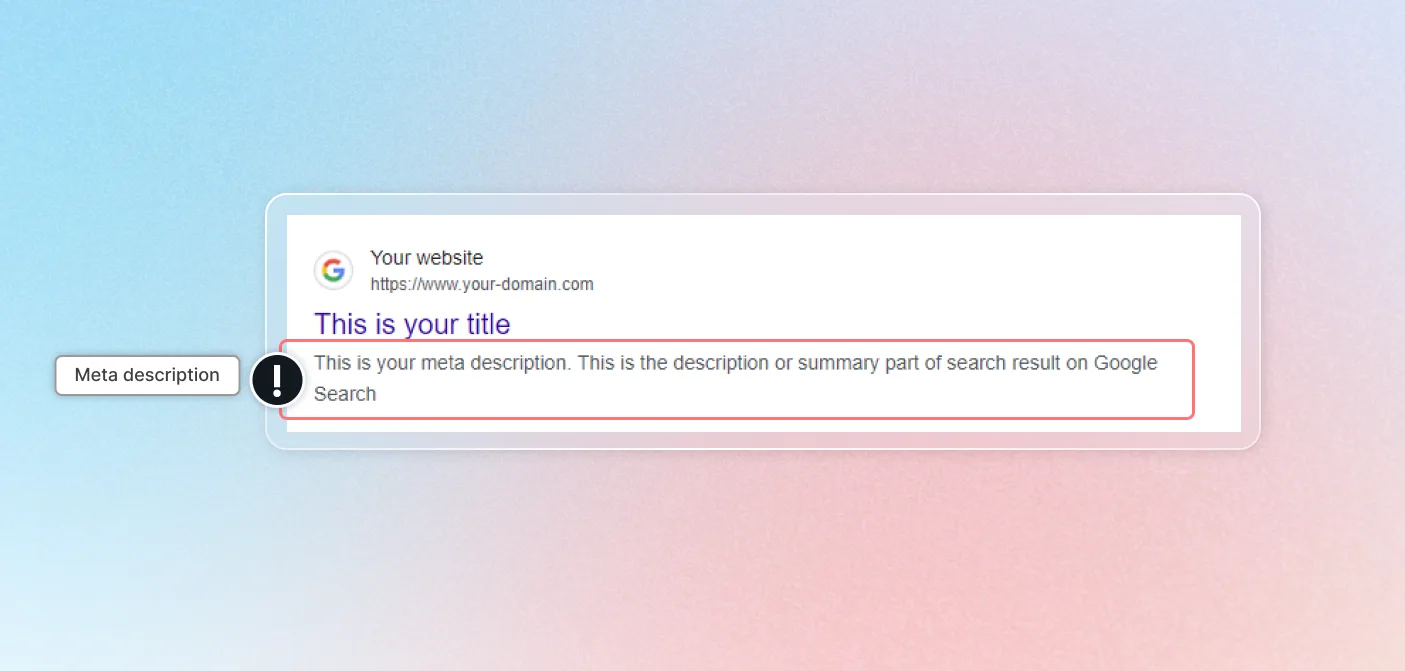
Meta description length off target
Meta description is the element below the title on the search results.
If often provides a summary of a page's content. This won't help direct with rankings but helps with click through rate.
Description length should be between 150 and 160 characters.
Learn more about meta description with Google. (opens in a new tab)
Missing main keyword in meta title
The main keyword does not appear in the meta title. The title tag is one of the strongest ranking signals.
Missing main keyword in meta description
The main keyword does not appear in the meta description. Google often bolds matching keywords in search results, improving click-through rates.
⁉️ FAQs
Missing FAQs
Your page has no FAQs. FAQs help users find answers quickly and make your page eligible for Google's rich results.
Missing main keyword in FAQs
None of your FAQ questions or answers contain the main keyword. Including it helps Google understand the relevance of your FAQs to the page topic.
Missing FAQ structured data
Your page has FAQs but no FAQ structured data (schema markup). Without it, Google cannot display your FAQs as rich results in search.
🔗 URL
URL length off target
The full URL exceeds 75 characters. Long URLs are harder for users to read and share, and may be truncated in search results.
A clean, well-structured URL helps search engines understand the content of your page and improves user experience.
Invalid characters in URL
The URL contains characters that are not recommended for SEO — such as uppercase letters, spaces, underscores, or special characters.
Missing main keyword in URL
The main keyword does not appear in the URL. Including it reinforces relevance for search engines.